
Change rarely happens by accident. It begins with a clear vision of what is no longer working and a willingness to imagine something better. Without that kind of ambition, change doesn’t come to us, we are simply overtaken by events.
For years, many of us hoped the state penitentiary would eventually move out of downtown Sioux Falls. That now appears to be happening. Fewer still believed we would ever see the day when the Morrell’s/Smithfield slaughterhouse would leave downtown. Yet here we are. Sometimes, big dreams really do come true.
At the February 16th announcement of Smithfield’s relocation, Governor Larry Rhoden remarked, “In South Dakota we don’t settle for the way things are. We strive to do better, and we strive to pursue opportunities.” The line was aspirational. The facts on the ground now give it substance.
When the Problem Is Obvious, sometimes it Gets Addressed
Everyone knew the Smithfield slaughterhouse no longer belonged in the heart of a growing city. Its location created environmental, land-use, and quality-of-life conflicts that were only getting worse as Sioux Falls expanded around it. Yet for decades, the problem felt permanent. The assumption was that nothing could be done.

Slaughterhouse in Sioux Falls
Mayor Paul TenHaken deserves credit for challenging that assumption. And thanks once again to Denny Sanford for using his resources to make good things happen.
By dreaming bigger than the status quo, the city is now on the path to reclaiming a large and strategically important piece of downtown while allowing Smithfield to operate more efficiently and cleanly in a location better suited to its needs.
The same logic applies to the state prison. South Dakota’s century-old penitentiary was clearly deficient, yet replacement seemed politically unrealistic for years. Now it, too, is being relocated to a more appropriate site. In both cases, leaders acknowledged reality and acted instead of deferring the problem for another generation.

100-year-old penitentiary
The Next Big Decision We’re Avoiding
These successes raise an uncomfortable question: if we can confront problems this large, why do we keep postponing others that are just as obvious?
The location of the state capitol is one of them. Demographics have shifted dramatically since Pierre was chosen as the seat of government, and the problems created by that location will only intensify. Yet the state is contemplating spending hundreds of millions of dollars to refurbish a hundred-year-old building rather than asking whether the location itself still makes sense.

Half of SD’s population lives in the SE corner of the state
Many quietly concede that relocation may someday be necessary—just not now. But spending vast sums to defer an inevitable decision is not prudence; it’s avoidance. If accessibility, workforce availability, and citizen engagement matter, then the question of where our government functions should be faced honestly and soon.
Cutting Property Taxes the Right Way
There is another structural issue almost entirely missing from today’s property-tax debate: the cost of redundant government infrastructure.
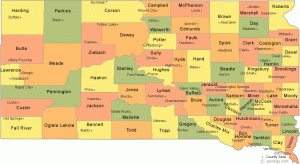
66 Counties in South Dakota
South Dakota prides itself on frugality and limited government, yet we maintain 66 counties and more than 150 school districts—an expensive web of administration and overhead. Lawmakers are searching for complex tax fixes while ignoring the most direct solution: reduce the size and duplication of government itself. Consolidation would lower costs permanently and ease the tax burden in a way temporary fixes never will.
One More Hard Conversation
Finally, there is the location of the Sioux Falls airport. The airport (specifically it use of fire suppression foam) has proven to be a more significant pollution source than even the more visible Smithfield and is far too close to the urban core. Our ground water has been poisoned with “forever chemicals” forcing the closing of some city water wells. There is no easy solution.

Sioux Falls Regional Airport
Aircraft noise, especially from regular military operations, can be overwhelming. Meanwhile, large developments under flight paths raise legitimate safety concerns. A modern airport located a few miles north or south of the city along I-29 would better serve both the region and city residents.
Will that happen? Probably not, but not long ago I would have said that about Smithfield moving.
Dreaming Big Works If We Follow Through
Recent events have shown that bold thinking in South Dakota is not naïve. It’s practical. When leaders confront reality instead of clinging to the status quo, real progress follows.
The lesson is simple: it doesn’t hurt to dream big. Sometimes, when we do, big ideas turn into decisions, and those decisions reshape our future for the better.
“Dreaming big” love it. Thank you Joe!!
It’s unfortunate that the Mayor of Sioux Falls is not running for statewide office. He has made a huge difference in Sioux Falls. With a statewide platform, he could accomplish much of what you’ve mentioned above. We’ve been talking about redundancy in government since Bill Janklow One.
Great commentary Joe! Very thought provoking and offers a plethora of possibilities. Dreaming big can be a good thing, especially if well researched, well thought out and fiscally responsible. However, we have many plans and ideas that have been costly but never acted upon. Shelved and probably forgotten. But we must continue to dream big because you just never know what can happen!!
I was in college in Denver when decisions were made to close Stapleton airport and build a new one way out in the middle of nowhere. That decision has led to billions of dollars of new investment, light rail, and a redevelopment of the old location. In hindsight, it was of course the right thing to do. And it was a really hard and contentious decision at the time.
Joe,
When Capitol is moved Hope the cross state Amtrak is approved along with so those of us out west can take the train to the Capitol if winter weather makes road travel difficult.
Amtrak may an Economic boost regardless!