
Sioux Falls voters went to the polls on June 2 to elect a new mayor and fill four city council seats. Yet only one of those five races was actually decided that day. The other four required runoff elections three weeks later. And in the runoff, the mayor’s race is still too close to call. That should lead us to ask a simple question: Is there a better way? There is.
It is called ranked choice voting, sometimes referred to as instant runoff voting. Instead of selecting just one candidate, voters rank the candidates in order of preference. They can rank as many, or as few, as they wish. If no candidate receives more than 50 percent of the first-choice votes, the candidate with the fewest votes is eliminated and those ballots are counted for each voter’s next choice. The process continues until one candidate has majority support.
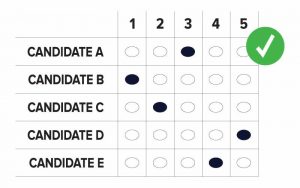
Instant Runoff Voting
The goal is exactly the same as Sioux Falls’ current runoff system: elect a candidate supported by a majority of voters. The difference is that it happens without requiring everyone to come back for another election a few weeks later. That matters.
Elections are expensive
Runoff elections are expensive for taxpayers. They require election workers, polling places and all the other costs of administering another citywide election. Candidates must immediately launch a second campaign after finishing the first one. More money must be raised. More mail must be sent. Volunteers must be recruited again. And voters are asked to make a second trip to the polls simply to finish an election that could have been completed the first time.
Not a partisan issue
Like many election reforms, ranked choice voting has its critics. Some assume it must benefit one political party over another. Others simply prefer the familiarity of the current system. But ranked choice voting is not a partisan idea. It is simply a different way of identifying the majority winner when several candidates divide the vote.
Nor is it an untested concept. Ranked choice voting is used in democracies around the world, in numerous American cities and counties, and statewide in Alaska and Maine. While no election system is perfect, millions of voters already use it successfully.

South Dakota currently does not allow cities to use ranked choice voting, even for nonpartisan municipal elections. That seems unnecessarily restrictive. Cities routinely make decisions about zoning, utilities, parks and dozens of other local matters. They should also be allowed to choose the election system that best serves their residents.
Sioux Falls is large enough that multi-candidate races are becoming more common. As the city continues to grow, runoff elections are likely to become more common as well. Before accepting that as inevitable, we should at least consider whether there is a simpler, less expensive alternative.
Making government work better
Election reform does not always have to be ideological. Sometimes it is simply about making government work better. This is one of those cases.
The purpose of an election is to identify the candidate with the broadest public support. If we can accomplish that fairly, accurately and transparently in a single trip to the polls, why wouldn’t we?
One election is enough.
Hope the SD Legislature reconsiders this badly needed system in 2027.
RANKED CHOICE VOTING’S TIME HAS COME. Start small with counties and cities to make folks more comfortable.
STATE LEGISLATURE—please give us the empowerment to give it a try.