
The Legislature Doesn’t Trust South Dakota Voters
This November, South Dakotans will once again be asked whether they want to give up some of their own power.
Amendment L would require future constitutional amendments to receive 60% of the vote instead of the simple majority that has governed South Dakota elections for more than a century. The proposal did not originate with citizens. It was placed on the ballot by the Legislature.
Voters Already Rejected This Idea
If this sounds familiar, it should. South Dakotans rejected a similar proposal just four years ago. Now they’re being asked to reconsider essentially the same idea.
For years, the Legislature has pursued one proposal after another to make it harder for citizens to use South Dakota’s initiative and referendum process. Some have been struck down by the courts. Others have been rejected by voters. A few have quietly died in the Senate. Yet every legislative session seems to produce another attempt.

South Dakota Invented Statewide Direct Democracy
South Dakota has every reason to be proud of its tradition of direct democracy. In 1898, our state became the first in the nation to adopt statewide initiative and referendum. The principle was simple: when elected officials fail to act, or act contrary to the wishes of the public, the people themselves retain the authority to make law.
That philosophy is reflected in our state motto: “Under God the People Rule.”
Over the past century, South Dakotans have used that authority to decide issues ranging from taxes and crime victims’ rights to Medicaid expansion, marijuana, abortion, ethics reform, and election laws. Whether one agrees with the outcomes is beside the point. The initiative process ensures that the final decision belongs to the voters.
A Long Campaign to Make Initiatives Harder
Amendment L did not appear in isolation. Over the past several years, legislators have proposed increasing signature requirements, shortening petition deadlines, imposing geographic distribution rules, restricting petition circulators, limiting funding sources, allowing petition signatures to be withdrawn after signing, and raising the percentage required for constitutional amendments.
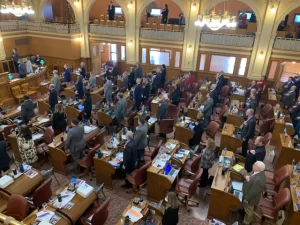
South Dakota Legislature
Individually, each proposal may seem modest. Collectively, they reveal a consistent pattern. The objective is almost always the same: make citizen-initiated measures more difficult to qualify for the ballot or more difficult to pass once they get there.
Perhaps one reason for these repeated efforts is that the Legislature often sits well to the right of the average South Dakota voter. Citizen initiatives give voters a way to enact policies that lawmakers would never approve, making the initiative process an important check on a Legislature that does not always reflect the views of the broader public.
Voters Have Already Answered This Question
South Dakotans have considered this issue before. In 2022, voters overwhelmingly rejected a legislatively referred constitutional amendment that would have required certain ballot measures involving taxes or large appropriations to receive 60% approval. Roughly two-thirds of voters said no.
Now the Legislature is back with a broader proposal. Amendment L would require every future constitutional amendment to clear a 60% hurdle.
The question for voters is not whether a particular amendment deserves support. It is whether future voters should find it significantly harder to amend their own constitution.
The System Is Already Demanding
Supporters of new restrictions often argue that changing the constitution should not be easy. On that point, there is little disagreement. It isn’t.
Sponsors must draft legally defensible language, survive multiple rounds of review, organize a statewide campaign, and collect tens of thousands of valid petition signatures before voters ever see the proposal. Professional signature gathering has become almost unavoidable because of the sheer size and complexity of the task. Then comes an expensive statewide campaign to persuade a majority of voters.
Very few initiatives ever make it that far. The process already contains substantial safeguards against casual or frivolous constitutional amendments.

Trust the Voters
At its core, Amendment L asks a simple question: Who should have the final say over South Dakota’s constitution, the people or the politicians?
Our founders answered that question in 1898 by giving citizens the initiative and referendum. They understood that representative government works best when voters retain the ability to act directly when necessary.
That principle is especially important when the Legislature and the public are not in complete agreement. The initiative process exists precisely because representative government does not always produce outcomes that reflect the views of the broader electorate. For more than 125 years, that balance has served South Dakota well.
The Legislature should certainly debate ideas. It should advocate for its positions. But it should stop returning year after year with new ways to make citizen lawmaking more difficult. “Under God the People Rule” is more than a motto. It is a governing principle worth preserving.
Good morning Joe. Thank you for again bringing your thoughtful, honest, intellectually sound perspective to the important issues we face as citizens in South Dakota. Your voice of reason is so very important. Please continue your invaluable work. Kind regards, Rich
Thank you for posting this Joe. Our current Lt. Governor, Tony Venhiezen, brought this bill in 2024. I spoke against it for all the reasons you state. However, it passed both the House and Senate. Can’t remember the vote total but I believe it was veto proof.
We need to vote NO and defeat it!
A key consideration that is often missing in the conversation on our process: “Under God the People Rule is more than a motto. It is a governing principle worth preserving;” and, “Trust The Voters” may legitmately result in legislation and regulation that some People may not favor.
There seems to be a high tolerance of poor voter participation which evident in most state and local elections.
Thanks Joe
Key fact:
Most attempts at changing the Constitution that are able to breach the gauntlet and get onto the ballot already fail. Including those put on the ballot by the Legislature to clean up or update language. They can’t even pass their own amendments at 50% +1. Historically, at 60%, very few would have passed.
Pass “L” and our constitution would be a dead document, that, unlike the US Constitution, contains considerable policy constraints, like interest rates, tax levels, property classifications, gaming, Medicaid, marijuana, land trust management requirements, and others. No just “NO”!
L NO!