
South Dakota’s closed primary system has turned Republican registration into something other than a measure of political identity. The state now has 329,769 registered Republicans, 53% of all registered voters. Are 53% of South Dakotans really Republicans? Probably not.
We got a fascinating glimpse of what may really be going on during this year’s Republican primary race for governor.
Something Happened in 2026
On April 22nd, South Dakota had 318,889 registered Republicans. By August 9th, that number had jumped to 329,769.
In less than four months:
- Republican registration increased 10,880
- Democratic registration declined 3,311
- Registration outside the two major parties declined 1,776
Did South Dakota suddenly become dramatically more Republican? Or did thousands of South Dakotans simply figure out how our election system works?
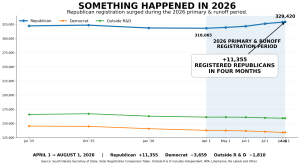
The surge occurred during the Republican primary and runoff for governor. Voters who wanted a meaningful voice in choosing our next governor had a powerful reason to register Republican. And thousands did.
Those voters now have a powerful reason to stay registered Republican.
45% of Americans Call Themselves Independent
That raises a broader question about what party registration really tells us.
We likely undercount our independent voters in South Dakota. Gallup reported in January that a record 45% of Americans identify politically as independents. Just 27% identify as Republicans and 27% as Democrats. Pew Research Center finds much the same thing, with 44% self-identifying as independent or “something else.”
Compare that with South Dakota. Only about 26% of our registered voters are outside the two major parties, while 53% are registered Republican.
Of course, conservative South Dakota is considerably more Republican than the country as a whole. But our election system also gives independent voters a very practical reason to register Republican. It gives them a primary vote that matters.
What Exactly Is a South Dakota Republican?
Various factions of the Republican Party, particularly those on the far right, regularly accuse other Republicans of being RINOs: Republicans In Name Only. But what exactly is a “real” South Dakota Republican?
Is it someone who agrees with the party platform? Someone who votes Republican most of the time? Someone who supports Republican candidates? Someone who participates in the party?
Or is it simply someone who checked the Republican box on a voter registration form? Under South Dakota law, that last answer is the only one that matters. You don’t take a loyalty oath. You don’t have to support Republican candidates. You don’t have to agree with the Republican platform. You don’t even have to think of yourself as a Republican.
You simply register as one. And our election system gives you a very good reason to do exactly that.
South Dakota Is a One-Party State
This wouldn’t matter nearly as much if South Dakota had two competitive political parties. But we don’t. Republicans dominate statewide elections and most legislative districts. In many races, the Republican primary is effectively the election that determines who will hold office.
Yet that election is closed to almost half of registered voters—the independents and Democrats. So, what should a moderate do if he wants a voice in choosing our governor? Register Republican.
What should an independent do? Register Republican.
What about a Democrat who wants to participate in picking the state’s leaders? Register Republican. You’d have a meaningful vote in the primary election and can vote for the Democrat (if there is one) in the general.
The rational response to our closed primary election system is increasingly obvious: if you want the greatest possible voice in choosing South Dakota’s leaders, register Republican.
The recent governor’s race made that incentive unusually visible. But some South Dakotans have been quietly making the same calculation for years.
Voters Are Figuring Out What It Takes to Participate in Important Decisions
South Dakota’s voter registration numbers therefore tell us something important, but perhaps not what we think they tell us.
Republican registration has grown from 51% in August 2024 to 53% today. Democratic registration has fallen from 24% to 22%.
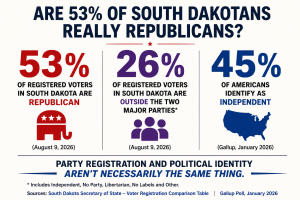
Meanwhile, about a quarter of South Dakota voters remain registered outside the two major parties.
Some of the Republican growth undoubtedly reflects South Dakota’s conservative political character and the declining strength of the Democratic Party. But the extraordinary movement surrounding this year’s Republican primary and runoff demonstrates something else. Party registration and political identity aren’t necessarily the same thing. When registration determines whether you can participate in the election that really matters, people will register accordingly.
The Parties Have No One to Blame but Themselves
Republicans who don’t like nontraditional Republicans participating in their primaries have no one to blame but the political system their party has helped preserve.
The political parties established and control a system that requires voters to affiliate with them to obtain full participation in our primary elections. That arrangement might have made more sense when South Dakota had two competitive parties. Each party selected its nominee, and voters then chose between two viable candidates in November. That’s not how it works in South Dakota anymore.
One party is no longer competitive in statewide elections and most legislative races. The remaining viable party therefore gets to make the important decisions about who leads our state. Increasingly, voters understand that. So, many are registering accordingly. Then party activists complain that some of those voters aren’t “real Republicans.” They may be right. But that’s the system they created. And they could correct it if they opened their primary.
Best Advice: Don’t Rush Back
And those who switched to Republican this year shouldn’t be in a hurry to switch back. The same closed primary system will be in place in the next election. Staying registered Republican preserves their ability to participate in the elections that often actually determine who governs South Dakota. If enough independents and moderates do that, they may even make Republican primaries more representative of the state as a whole.
If South Dakota wants party registration to mean something, it should stop making party registration the price of admission for having a meaningful voice in state-financed elections.
Until then, the smart advice for many South Dakota voters is pretty simple: Want a voice? Stay registered Republican.
“ If South Dakota wants party registration to mean something, it should stop making party registration the price of admission for having a meaningful voice in state-financed elections”
100%