
We worry about affordable housing, child care and the cost of living. But perhaps the bigger problem is that South Dakotans don’t earn enough.
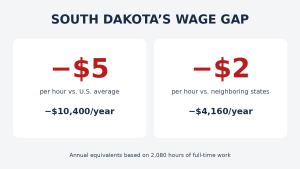
At a recent South Dakota Chamber of Commerce and Industry meeting, I learned something that should concern all of us. South Dakota’s average hourly wages are approximately $5 below the national average and $2 below the average of our neighboring states.
Think about what that means. A South Dakotan working full time earns roughly $10,000 less annually than the average American worker, and $4,000 less than workers in neighboring states.
That’s a lot of money, particularly for families struggling to pay for housing, child care, health care and other necessities. And it raises a question we don’t discuss nearly enough: Does South Dakota have an affordability problem, or do we have a wage problem?
Our Traditional Economic Model
South Dakota likes to tell itself a simple story: low taxes, small government and fiscal discipline have produced one of America’s best-run states.
There is considerable truth in that. We have no personal or corporate income tax, maintain balanced budgets, enjoy excellent bond ratings and operate one of the best-funded public pension systems in the country.
Our business-friendly climate has attracted employers and helped produce consistently low unemployment. By many conventional measures, South Dakota has been an economic success. But there is another side to that story.
Our traditional economic development model has emphasized low taxes, low costs and a favorable business environment. It has been less successful at generating the higher-paying jobs that allow ordinary wage earners to get ahead.
The Other Side of Affordability
Consider affordable housing, one of the most frequently discussed challenges facing Sioux Falls and other growing South Dakota communities. We talk about reducing construction costs, encouraging smaller homes, relaxing zoning requirements and subsidizing affordable housing projects. Those may all be worthwhile approaches.
But affordability is a relationship between what something costs and what people earn. A family earning $80,000 can afford considerably more housing than a family earning $60,000.
The same principle applies to child care. We struggle to make it affordable for parents while paying child care workers enough to attract and retain qualified people. Higher wages throughout the economy would help families pay for child care, although the industry would still face difficult cost pressures of its own.
Health care, groceries, transportation and retirement savings present similar challenges. We tend to approach each affordability problem separately, when one common factor is that many South Dakotans simply don’t earn enough.
Who Benefits From Our Economy?
South Dakota’s per-capita personal income often looks respectable. But that statistic includes farm profits, business income, investment returns, retirement income and other sources of wealth.
Our economy has been reasonably successful for many people who own land, businesses and investments. It has been less successful for people who depend primarily on wages.
We also have an unusually high percentage of mothers in the workforce. That is sometimes celebrated as evidence of our strong work ethic, and it certainly is. But it may also reflect the difficulty of supporting a family on one income.
Quality Jobs, Not Just More Jobs
For decades, South Dakota has promoted its low-cost business environment as an economic development advantage. Low taxes, inexpensive facilities and relatively low labor costs can be attractive to employers.
But low wages are an advantage for employers, not necessarily for employees. And an economy built around inexpensive labor is unlikely to produce the prosperity we want for working families.
This is not a criticism of South Dakota employers, many of whom provide good jobs and competitive wages within their industries. The larger problem is the mix of industries in our state, with too few businesses in the high-wage sectors that could lift our overall earnings.
This raises an important question about government economic development efforts. Too often, success is measured by the number of jobs created, the number of businesses recruited or the amount of investment announced. We should be measuring the quality of the jobs, not simply counting them.
Attracting another employer offering hundreds of low-paying positions may increase employment, but it does little to improve our overall wage picture. In a state that already has very low unemployment, creating more low-wage jobs may simply intensify competition for workers without significantly improving their standard of living.
When government provides incentives, infrastructure or other assistance to attract businesses, the wages and benefits those businesses offer should be central to the decision. Higher-paying jobs, opportunities for advancement and long-term economic benefits should matter more than impressive job creation announcements.
Investing in Higher Wages
South Dakota ranks poorly in teacher compensation and has historically invested relatively little in university research, innovation, venture capital and other activities that generate higher-paying employment.
We have emphasized keeping government inexpensive rather than asking whether strategic investments could make our citizens more prosperous.
We should be asking different questions. What industries offer the greatest potential for higher-paying jobs? How can our universities become stronger engines of economic growth? What investments in education, workforce development, research and entrepreneurship would raise incomes over time?
And how can we help existing South Dakota businesses become more productive, innovative and capable of paying their employees more?
A Better Measure of Success
South Dakota has plenty to be proud of. Our fiscal discipline, entrepreneurial culture and strong work ethic have served us well.
But low taxes and low unemployment aren’t enough. A state can be inexpensive to operate and still leave too many working families struggling financially.
We should continue addressing the cost of housing, child care and other necessities. But we also need to address the other side of the affordability equation.
Instead of concentrating so much on making South Dakota a low-cost place to do business, perhaps it’s time to concentrate on making it a better-paying place to work.
Absolutely spot on!
Thank you Joe.
South Dakota’s biggest export is young educated people seeking their fortunes elsewhere. It’s both the lack of high paying jobs and the conservative politics that drive them away. Even some of my favorite Republican former students find that their personal values are better matched with those living in the Twin Cities, so they move. Low taxes will not bring them back—well maybe in retirement.
Would you please run for governor, Joe? Wait this kind of growth logic would never go in our current legislature. But t I agree with you 100%.
Very thoughtful read. Your focus on the the parts of the argument few want to talk about is absolutely on target. Thanks Joe
Agreed. But how does the Sioux Falls MSA compare? State averages include the reservations.
Our economic development message has for years sounded like a nest of newly-born sparrows: “Cheep, cheep, cheap!” We can—and should—better than that. We ARE better than that.
Excellent post, Joe.